MY FIRST PRISON VISIT
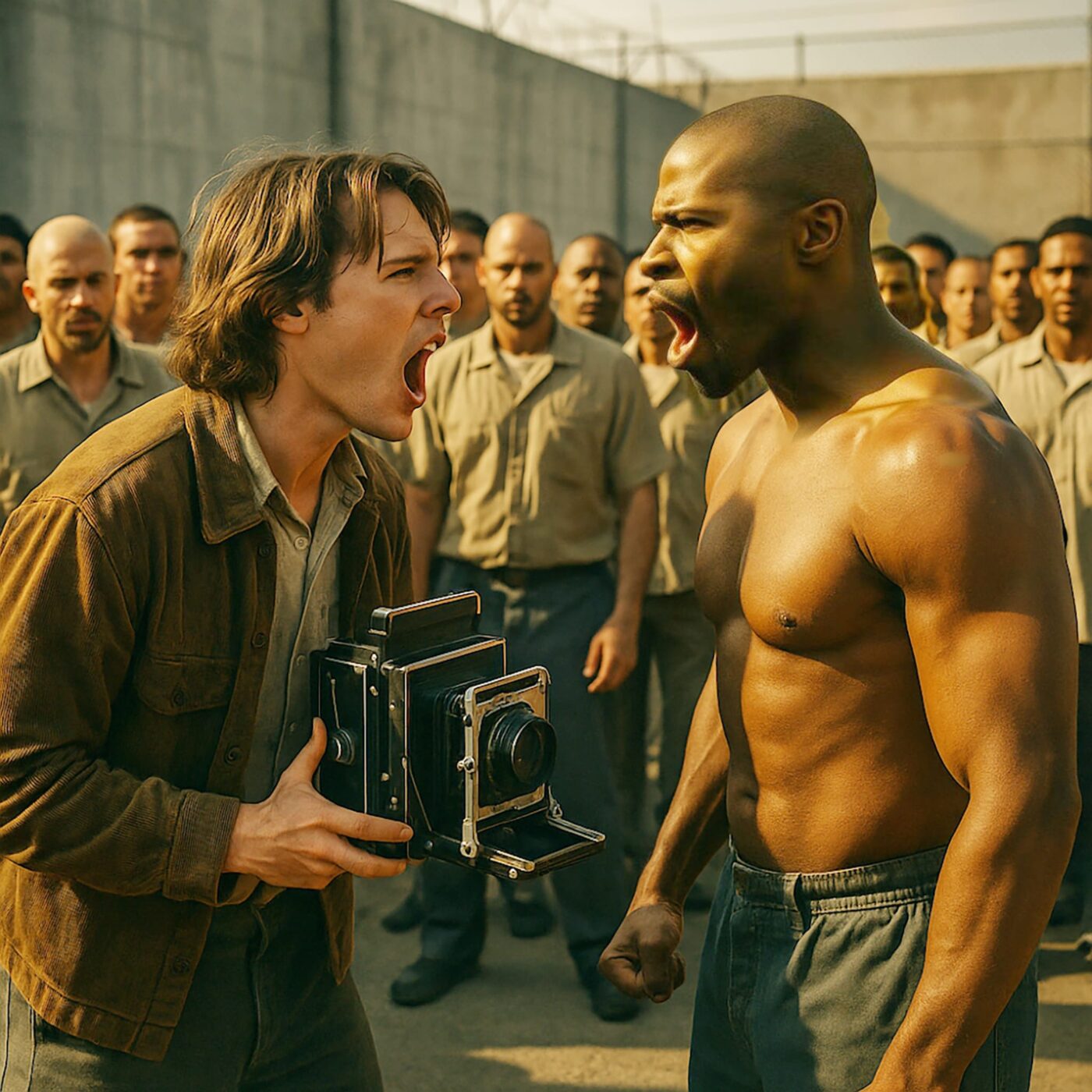
“What do you think we are—animals?!”
The inmate was screaming at me, veins bulging, eyes fierce. Around us, prisoners started swarming like bees to a hive. And the assistant warden who was supposed to keep me safe? Gone. Vanished as quickly as a magician’s rabbit. In that moment, I thought: my first prison photo shoot might also be my last.
But let me back up.
Years ago, when I was still a student at Art Center, I was taking a portrait class. The instructor wanted us to push ourselves—to do something different. “Think outside the box,” he told us. So I did.
I contacted the Department of Corrections and discovered that Chino State Prison wasn’t too far away. I wanted to go there and shoot meaningful, dramatic portraits of the inmates. And to make it extra special, I decided to use a 4×5 view camera—the old-style camera that shoots a large negative, where you have to go under a black cloth to focus. Don’t ask me how I convinced the state officials to let a 22-year-old student photograph inside a prison—but somehow, I did.
When I arrived, I was greeted by the assistant warden, whose job was to show me around the prison and keep me safe.
Chino has a hot, dry climate, so a lot of the inmates walked around shirtless, showing off their muscular builds. I noticed that many of them had strings tied through their nipples. Naturally, I asked about it. Turns out, it was a sign of which gang they were in—depending on which nipple, and how many knots were in the string.
I would spot someone who I thought had a compelling look, take some shots, and then move on to another location. After we passed the main courtyard and reached a shaded overhang area, one of the inmates suddenly began yelling at me.
“What do you think we are—animals? Are we just here for your entertainment? You think you can just come in here and walk around like you own the place?!”
The commotion created quite a stir. He wouldn’t stop yelling, getting right in my face. The next thing I knew, the entire prison population was surrounding us, buzzing like bees around a hive. And they were getting riled up, too. I turned to look for my escort—but he was gone. He’d disappeared pretty quickly as other inmates started joining in.
So there I was. Alone, in the middle of a hive of angry prison inmates. What should I do?
Well, I faced the man who’d started the upheaval and began yelling back. In the animal world, it’s the one who looks weakest who gets torn to shreds. But my words weren’t condescending. They were words of explanation.
“Look how you live in this place! Look at what you have to go through! Do you think people on the outside know this—or understand it? I’m here to capture the emotions of this place so others can see it!”
I’ve always found it helps to be truthful—it’s just a matter of how you present that truth.
Next thing I knew, this same man who’d been full of fury a moment earlier put his arm around me and volunteered to be my new escort. Believe me, I felt much safer with him.
I got some great shots. But it was so many years ago that I can no longer find them. I hope to someday. Still, it was certainly a great lesson in how to think on my feet.